

Environmental Racism is a type of systemic racism where low income communities, predominantly communities of color, are predisposed to experiences the impacts of climate change due to policies, practices, and systematic disadvantages. This promotes high pollution environments in these communities, which often leads to health issues for its residents. It is often a neglected topic, and when it is discussed, it is primarily in academic settings or by activists for affected communities. This topic is examined primarily in two groups, advocates for groups impacted most, and in academic settings.
Examining the Intersection of Systematic Racism and the Environmental Movement through Texts
What is Environmental Racism?



In this video, Joycelyn Longdon, a PhD student at Cambridge provides an overview of Environmental Racism, and its connection to systematic racism specifically in regards to the US and the UK. She begins by introducing herself with her credentials and purpose in advocating for climate change and people of color. We are provided with extra resources like her instagram and educational page to reinforce this.
As her video begins, she calls attention to the the disproportionate nature of global warming in regards to race. She specifically highlights the actions of Indigenous people; despite composing of only 5% of the worlds population Indigenous people protect 80% of the worlds biodiversity. Joycelyn then shifts to other facts centering on climate change and racism. Included in this examination is how developing countries and communities are "climate vulnerable" due to the rapidly changing climate and improper resources. However, the same communities that are most vulnerable to climate change are not the ones causing it. 50% of carbon emissions are being produced by just 10% of the worlds population. In her introduction of these statistics, Joycelyn continues using a calm and informative, yet educational tone. Her combination of approachability with effective statistics and information makes her video highly effective in its purpose.
Joycelyn introduces the multifaceted nature of environmental racism and its impacts, within this discussion she begins the discussion two intertwined populations: the communities impacted by climate change and environmental racism, typically lower income and communities of color, and advocates for these communities and the climate.
After her introduction of attention-catching facts, she defines complex words often used in the discussion of this topic. "Racism", "Systematic Racism", and "Environmental Racism" are all defined and examined in the contexts of society today. Her baseline establishment of these terms furthers her purpose to inform audiences, and allows for an accurate understanding of nuanced ideas later on.
Examples of systematic racism are then provided in the form of the petrochemical corridor, cancer alley, and other cases where corporations release toxic waste, carcinogens, or cancer causing materials in communities of color, due to social status, economic status, location, or other state. The order the information was provided allows for the audience to first understand some of the explanation behind these issues, then
how they manifest.



Another place Environmental Racism is discussed is in context of social media, specifically by advocated for impacted communities.
Xiye Bastida, a Mexican Climate activist, is one of the primary organizers of Fridays for Future New York City and has been a leading voice for indigenous and immigrant visibility in climate activism. Through her tweets, Xiye expresses powerful expressions of climate activism, especially in confronting those who have conflicting opinions about climate change and racism. She centers her ideas on the intersection of poverty due to systematic racism, and how climate change impacts people of color disproportionately.
In the above tweets, Xiye is countering many of the common ideas that are held about climate change through a blunt approach that forces her audience to consider “system[s] of exploitation”, or the “dispossession of imperialism”. With this, her tweets are in a mix of English and Spanish, which is indicative of her target audience, heritage, and community. In the translated (longer) tweets, her utilization of Spanish makes her word more accessible to her target audience, which in this case, is not American Politicians or people in positions of power. Here she is directly speaking to communities who are impacted by climate change, and those who are interested in this issue.
However, in her second tweet, Xiye is targeting a new audience. Her tweet is in English, and paired with rhetorical questions, complex sentence structure, and inclusive language such as “we”. This indicates that here, she is aiming to unite a wider audience into fighting for climate justice, and compelling them to rethink their complacency regarding communities impacted by climate change. This is especially highlighted through her statement “we shouldn’t have to see the effects of the climate crisis to act…we shouldn’t stand for it”, she then reminds the audience of “Pakistan, Puerto Rico, [and] now Floridia”, then posing the question of “who tomorrow?” This highly effective use of language, paired with a variety of places impacted by the climate crisis, make her claims far more effective and emotionally provoking to her audience.
The use of social media as a tool to reach audiences is particularly powerful because it allows groups who face unfair treatment or are expereincing the brunt of climate change to freely express their ideas, with potential to reach large audiences. Although the idea of the 'algorithm' will always be around, social media remains a simple way for outreach.

LEAH THOMAS
Examining the
Black Woman
SAVIOR TROPE

Leah Thomas is a climate activist who aims to raise awareness of how climate change most hurts communities of color. She examines how to dismantle systems of oppression in context of the environmental movement.
Leah Thomas is another advocate for impacted communities on social media. She uses a combination of her pwn website, with Instagram to be the most effective in her purpose. The intersectional environmentalist account is moving a complex and interdisciplinary issue to a commonly used social media platform. Leah Thomas, the owner of the account aims to promote a "more equitable + diverse future of environmentalism”. In this post, Thomas uses an aesthetic design to attract viewers to the script, then using large, simple and unambiguous language to convey her point. She also underlines critical points of her argument to reinforce their important nature. This tactful use of trends allows a less trendy idea to be conveyed to a wider audience through the use of social media. As mentioned before, much of the discussion of environmental racism is in an academic setting. Leah is combatting this with her platform, and introducing an unfamiliar audience to novel social topics.
With this, the various text sizes allow for more pressing ideas to be pushed forward, which supporting evidence is provided for invested readers, but clarity is still emphasized. If you click on the link to engage with this post, you will also see a list of resources and texts to further engage with this topic after seeing the initial post. This includes the “I Am Not Your Savior: A Black Woman Savior Trope”. The Black woman savior trope stems from racism, and stems from the idea of Black women as soldiers, who are always “ready”, “capable”, and nearly superhuman. The intersections between race and gender have historically cultivated oppression against Black woman, yet an expectation for them to take on the “burden of societies ills without complaint or recognition”. This can be seen throughout history through the many Black woman who have been enslaved, oppressed, taken advantage of, or sacrificed, for the sake of society. The idea of a “Strong Black Woman” is rooted in racism, and used to justify mistreatment, discrimination and exploitation of Black women because they are “strong “enough to handle it”.

<<< click through to read analysis >>>


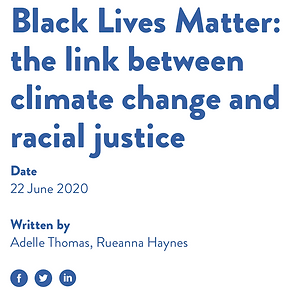


The article "Black Lived Matter: the link between climate change and racial justice", Environmental Racism is tackled in a way that is accessible for a large population of media-consuming adults. This article is easily found on the Climate Analytics Blog, among other sites.
In American society, marginalized groups face unfair treatment solely because of their race. With this, the impacts of human-produced climate change are increasing. Despite the prevalence of these two issues, many disregard their interconnectedness. This article attempts to address these two overlapping issues and show their importance. Within this article, the author begins by defining the Black Lives Matter movement and relating it to global warming. They provide a summary of the events leading to the BLM movement, along with its reasons. The author then ties in the influence of racism on climate change, and how it is highlighted through the disproportionate deaths of Black and Native American due to COVID-19. They go on to assert that “the impacts of the pandemic have laid bare the striking inequality in the US and its racist dimensions”. Experts such as Patrisse Cullors and Nyeusi Nguvu’s thoughts are also highlighted, providing confidence in the authors, and their information. They go on to examine the intertwined nature of racial injustice and climate change, and how one cannot be remedied without the other. They further cite direct linkages between the two topics such as “residential segregation, unequal educational opportunities, and limited prospects for economic advancement” that have resulted in the increased vulnerability of people of color in the climate crisis and other global crisises. Through this article, the author counters popular ideas about the Black Lives Matter movement, and demonstrates the multifaceted application of its message.
This article touches on the idea of intersectionality between environmental racism and vulnerabilities to other natural disasters. This addition by the authors begins to touch on the overarching theme of systematic disadvantage to minority groups, and how they are impacted in nearly every aspect of life. This article also demonstrates how this issue is discussed in society. Most Americans aren't seeking academic papers, instead this would be something they would gravitate toward.
CONCLUSION
Many of the discussions of environmental racism exist on social media, by advocates for impacted communities. Social media has allowed for these activists to reacher larger audiences without needing the help of a politician or similar figure. It is not often that you will hear a politician or person in power discussing this topic. Moreover, social media is such a strong tool to explore this topic with because it is easier to be heard in comparison to typical media. With social media, you can bypass screenings and less engagement due to the profiting nature of media today. Instead, people can hear firsthand from the voices most impacted. The general examination of this topic in traditional media is limited, and generally discussed less nuance than that on social media or academic papers.
Ultimately, the texts that are the most effective in educating the audience about environmental racism are the ones written by the communities impacted, or have firsthand experience with those communities. These sources are: Leah Thomas' Instagram, Xiye Bastida's Tweets, and Joycelyn Longdon's video. Sources like Black Lives Matter: the link... are effective in their purpose to inform broadly, but the most powerful voices in the fight against climate change and racism, are the ones being most directly affected.


Works Cited:
Bastida, Xiyc. "Xiye Bastida Twitter." Twitter, Twitter, ho /twitter.com/xiyebastida?lang=en.
Black Lives Matter: The Link between Climate Change and Racial Justice. Climate Analytics Blog, https://climateanalyt ics.org/blog/2020/black-lives-matter-the-link-between-climate-change-and-racial-justice/.
Kaufman, Joel D., and Anjum Hajat. "Confronting Environmental Racism." Environmental Health Perspectives, vol. 129, no. 5, May 2021, P. 51001. Gale In Context: Environmental Studies, link.gale.com/apps/doc/A664621939/GRNR?u- wash_main&sid-bookmark-GRNR&exid=2b29bfs
d. Accessed 12 Feb. 2023.
Thomas, Leah [IntersectionalEnvironmentalist). "Black Woman Savior Trope™* Instagram, May 11, 2022, https://www.i nstagram.com/p/Cdbsascu-sE/Zutm_source-ig_cmbed&ig_rid-7c2acoza-9352-4fdr-802b-926ccdezes9:
'What Is Environmental Racism?" YouTube, You Tube, 7 June 2020, https://www.youtube.com/wateh°v-ZuC]dNbalk.