Name: Reagan Ince
Identity:
Sociology and Informatics
Finding out through Failure
My third chemistry midterm was a notable moment in my undergraduate experience. In high school, I was a straight A student and a bad grade on a test was rare for me. However, my experiences in college classes have been different, and have required me to approach my classes with more effort than I have in the past. This is reflective of this midterm grade. Going forward, I will have to change the way I approach my classes, and need to start preparing further in advance which I have since implemented!
In Winter of 2023, I took Chem 152! Entering the quarter, I had heard of its less than stellar reputation, but I didn't pay it much mind. The previous class (142), hadn't been super challenging, and for the most part I treated it like many of my other classes, enjoying the content and putting in the work.
As I progressed through Chem 152, however, I realized that this class was much more reliant on applied formulas and math rather than concepts. This was something that at the time of writing, I am still not the most proficient at. Despite this, my study habits remained relatively unchanged. I studied well for my first midterm and performed well compared to the rest of the class. According to my professor, "The average on the exam was 58% ± 18% (standard deviation). The median was 57%". Unfortunately, I was unable to continue the momentum into midterm two, and scored significantly lower than my peers.
After midterm 3, I experienced the loss of a relationship which previously was incredibly important to me, and was in the process of grieving. I was unable to take the third midterm due to illness. And was similarly unable to study for the final.
The experience of loss was not new to me prior to this point. However, it allowed me to shift my perspective on what I truly want in my life. Through my experience of loss, I learned that grades are not the end all be all. This furthers a theme I was beginning to explore in AUT 22, and has only become more apparent. I will always strive to be the best I can be, and do the best I can in each class, task, or project I take on. But I also want to live a life worth living, and experience the emotions that come with that life. I am sure I could have done better in this class under different circumstances, but I am proud of how I did in the context of my life.


Narrowing Interests:
CSE 121 (SPR23)
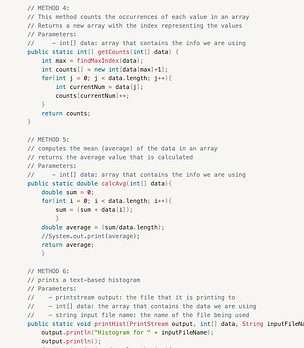
This artifact is a reflection of my learning in my first Java based programming course. Taken as a prerequisite for Informatics, within this program the user gives an input file name and output file name, and the program will turn a series of numbers into a histogram. I thought this program was especially fun, and intersected my interests in data visualization as well as programming.
Finding Success within Interests!
CSE 122 (AUT23)
On my CSE 121 final exam, I scored a 2/6 (S, N, E, N, S, N).
On my most recent 122 final exam, I score a 4.5/6 (E, N, E, E, S, E).
N = Not Satisfactory
S = Satisfactory
E = Excellent




CSE 390 A/B Honors - Wanting to Explore More (WI24)
I enrolled in the Honors CSE Sequence Concurrently with both CSE 122 and CSE 123. The aim of these courses was to address the limitations of CS particularly in a moral and ethic sense, and how many of these aspects can be reduced. Although I found some aspects of these courses to be interesting, I found that they were more reflective of simplifications of complex social phenomena, and there was a lot more content that I wanted to explore.
However, despite this, I found myself critically engaging with the context and commentary. One particularly notable example was when my professor commented that the reason zip-codes are a predictor of race is because people like to live with others who are similar to them. Although I didn't get the change to respond, I found myself internally disagreeing. Instead pointing out this trend with historical patterns such as redlining and segregation.
In these classes we read Algorithms of Oppression and Weapons of Math Destruction. Although I found these both to be very insightful, I wished there was more substantive literature, particularly highlighting the historical significance, and ways to address this issue. Media like this has been explored in other classes I have taken, specifically Science, Technology and Inequality taught by Kessie Alexandre. Here we explored the vast implications of technology, notably its development and how it systematically disadvantages marginalized communities. The most memorable examples were: the intentional development of cameras and infrared sensors to capture pale complexions and therefore be ineffective on black people; facial recognition usage by the police and how due to the technology fails at recognizing differences in dark complexions, black people are often arrested for crimes they did not commit; the biased nature of search engine, particularly examined through Safiya Noble's book "Algorithms of Oppression" (If you haven't read it I highly recommend!). We also discussed motifs such as hypervisibilty and invisibility and its implications on minority communities.
Ultimately, as I reflect on the experience between both classes I am incredibly grateful for my education in Professor Alexandre's course, and its ability to inform a critical understanding in other settings.
Here is my final from CSE 390 HB taken Winter 2024!
Advocating for Myself & Exploring New Interests - SOC301C WIN24
This quarter I took my first Sociology class, SOC301 Processes of Inclusion and Exclusionary in Contemporary Immigration. I throughly enjoyed this course, and expanded my perception and perspective on immigration as well as the narratives that surround it particularly within the US. Within this, I connected many of the motifs that we were discussing in class to my experience. Specifically, for our midterm policy paper, I explored CA AB 1045 Licensed Physicians and Dentists from Mexico Pilot Program. Within the grading and submission of this I received a less than ideal grade, instead of just moving on I had a conversation with my TA and ended up receiving full points. The process of advocating for myself, as well as what I learned in the class, particularly reflecting on how systems and instuitions I am a part of in/exclude immigrants, promoted self growth.
LSJ 375/SOC 372: Crime, Politics, & Justice
Dear Friend, In theory, the American criminal legal system aims to punish individuals through punitive measures and incarceration, depending on the severity of the offense and its context. It works to disincentive crime and punish those who commit crime. The criminal justice system, particularly courts, employ an adversarial system, with prosecutors and defense attorneys working to both assert their version of the story. However, the criminal justice system’s historic role in maintaining hierarchy within society contributes to its contemporary role in maintaining systems of power and disenfranchised marginalized communities and people. The racist origins of policing, and their role as slave catchers explicitly working to uphold Jim Crow laws, is one example of this. As I reflect on my enhanced understanding of the American criminal legal system, many of the themes that stand out to me reflect the bias and injustice inherent in the system. I have always been positioned within the opinion that marginalized communities are more susceptible to discrimination and violence, but as I have deepened my understanding of the structures that work to uphold this system, the pervasiveness of the issue has become increasingly apparent. This class worked to highlight many of the issues rooted in legislature and governing bodies that work to uphold structures of power. I found this especially emphasized through vagrancy laws, and similar ways deference to police manifests in law. Beyond this, through the Case Analysis and Film Analytical Assignment, I was able to engage in critical literacy regarding many of the systems of power that operate around my community, and acknowledge the very real ways these systems work to disenfranchise people on the basis of their class. This has provided me with the foundation to question the many institutions that I operate within and around. The intersection between criminalization of class is something that also stood out to me, namely the ways criminalization of immigration, poverty, housing status, race, disability, and mental health, all correspond to disenfranchise people who are the most vulnerable. Moreover, the punitive and fiscal oriented nature of the criminal justice system perpetuates cycles of poverty and incarceration within these communities. From the high cost of obtaining legal counsel, to fines and fees, bail, etc., adequate navigation of the criminal justice system is unobtainable to many. The systems of accountability that exist within these institutions are similarly ineffective in creating change. This was illustrated through the consent decree issued by the Department of Justice to the Seattle Police Department, and the continued racial violence enacted by the SPD. Examining the case of Terry Caver and other similar people harmed by the SPD highlights the pervasiveness of the issue, and the need for additional systems of accountability. Ultimately, the criminal justice system, although intended to punish people who commit crime and deter crimes, leads to perpetuating cycles of poverty and incarceration.
Info 201: Foundational Skills for Data Science SPR 24
This course allowed me to explore tools commonly employed in data science, this includes: HTML, C design aspects, R coding, Shiny app, among other tools. As a final for this class, we created a website reflecting on a chosen data set. I chose to work with a crime data set, since it reflects much of my other sociological coursework, and allows me to employ an interdisciplinary perspective to my education.
I will note that the Key Takeaways from Each Chart, and Chart 3 reflect another group members work, since Chart 3 doesn't work, and the Key Takeaways duplicate many of the points made in the conclusion.